Painter, sculptor, musician, writer — “I have no style, so I am free.”
Early years and the Rietveld Academy
Peter Klashorst was born on 11 February 1957 in Santpoort, the Netherlands. By his own account he started selling paintings door to door at the age of eight — “nothing really changed since then.” He trained at the Gerrit Rietveld Academie in Amsterdam, where in 1979 he moved to the newly founded Audiovisual department. It was a chaotic, open place that suited him: students made magazines and comics and even ran a pirate broadcaster. With fellow student Maarten van der Ploeg he formed the new wave band Soviet Sex, with Klashorst on bass. The band became popular in the Amsterdam squatter scene and released the LP *Happy End* (1982).
A New Wild One
Painting is what made his name. Within a few years of leaving the academy he received the Buning Brongers Prize (1982) and the Royal Subsidy for Free Painting (1983). His colourful, wild canvases, full of references to popular culture and art history, placed him among the Dutch representatives of the Neue Wilden — the European movement that brought expressive, figurative painting back after the dominance of minimal and conceptual art. Frequent media appearances made him a nationally known figure.
New York
Klashorst then took on New York. He found galleries there and exhibited alongside, among others, Jeff Koons. His big breakthrough did not come, partly because he refused to keep painting what his dealers wanted and switched to abstraction. Looking back, he said he should have stayed in New York when he had some success, but that the art politics there were not for him.
After Nature
Back in Amsterdam he co-founded the collective **After Nature** with Bart Domburg and Jurriaan van Hall (1989), later joined by the brothers Gijs, Justus and Aad Donker and New York–based Ernst Voss. Their programme was simple: paint what you see — still lifes, landscapes, portraits — and make art that anyone can understand. They painted live in galleries and at fairs, but also in the street, on trains and in nightclubs. Critics were often hostile; the public loved it. A residency at a well-known New York gallery was a highlight before the group was dissolved in the 1990s.
Africa and Asia
From the late 1990s Klashorst lived and worked in Africa — Senegal, Kenya and the Gambia — painting portraits and nudes of local models and making painted wooden sculptures, “three-dimensional paintings”. The period brought him into the news more than once and his life story, rather than his painting, became the focus of public attention, including the biography *King Klashorst* by Robert Vuijsje. Later he settled in Southeast Asia, working from Bangkok and Phnom Penh. In 2011 a series of some fifty portraits was shown at the Tuol Sleng Genocide Museum (S-21) in Phnom Penh, honouring the victims of the Khmer Rouge — an exhibition that drew international press attention and controversy.
Writer
In 2011 he published his autobiographical novel *Kunstkannibaal* (Prometheus), a picaresque book in the tradition of *Ik, Jan Cremer*, presented at the Supperclub in Amsterdam. Joost Zwagerman suggested it could just as well have been called “Ik, Peter Klashorst”. In 2020 the privately published art book *Dirty Diaries* followed, with stories in English.
Technique
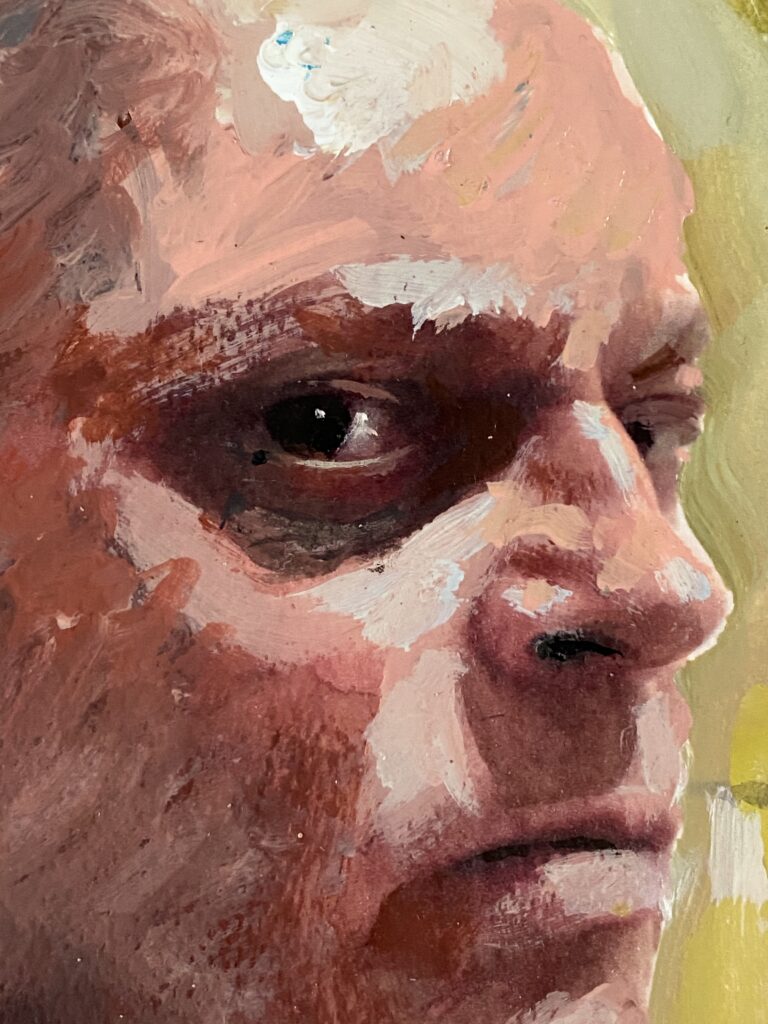
He began very traditionally, with oil on wood panel, but over time used “any material I can get my hands on”: oils, car paint and spray paint, on PVC instead of canvas. He liked the modern feel of plastic: the paint stays on the surface and keeps its shine. His heroes ranged from Caravaggio, Michelangelo, Picasso and Bacon to Carl Barks and Robert Crumb. A good painting, he believed, should never be in perfect balance: there must be an irritation point that pulls the eye, as in Rembrandt, whose unfinished passages let viewers complete the work in their own imagination.
Legacy
Peter Klashorst died in Amsterdam on 11 September 2024, aged 67. He never wanted to be a “one trick pony” repeating a formula for collectors. For him, art was “about freedom and not success and money”. The works on this site — paintings on PVC, on canvas and works on paper — span that restless search.
In the studio
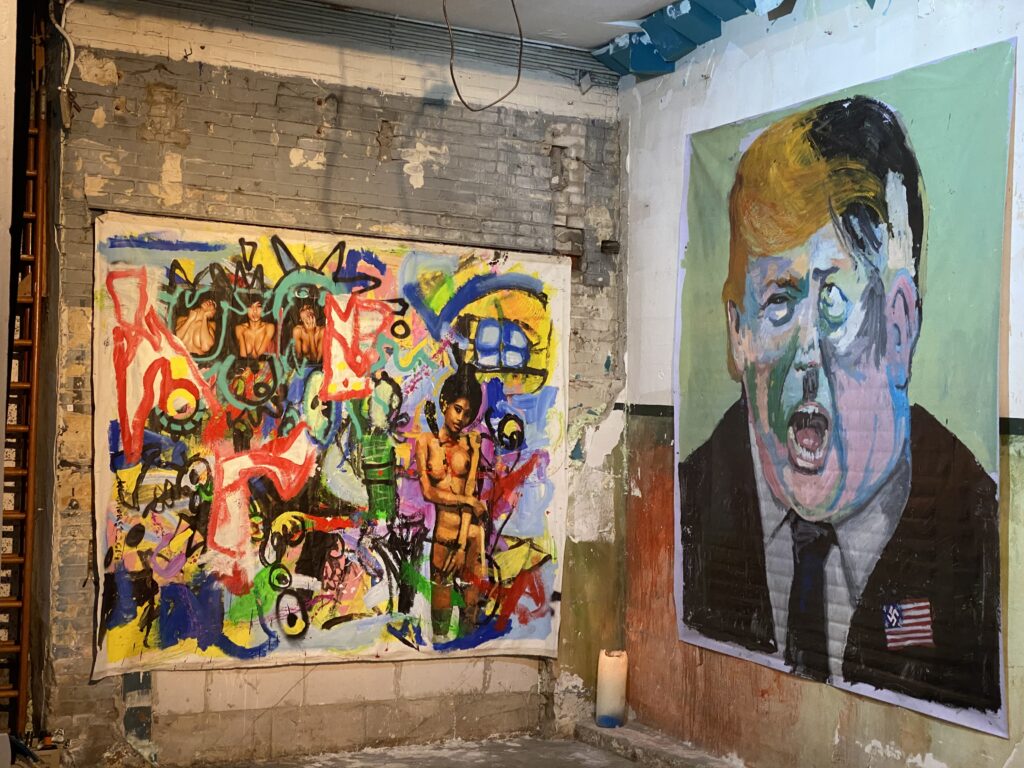
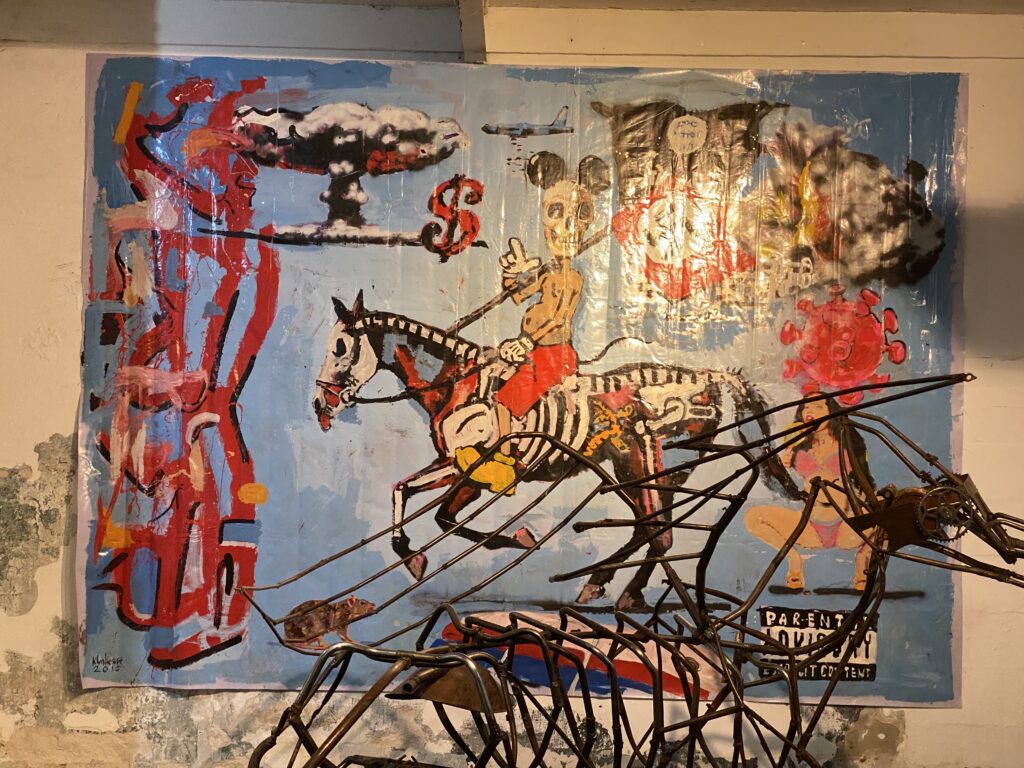
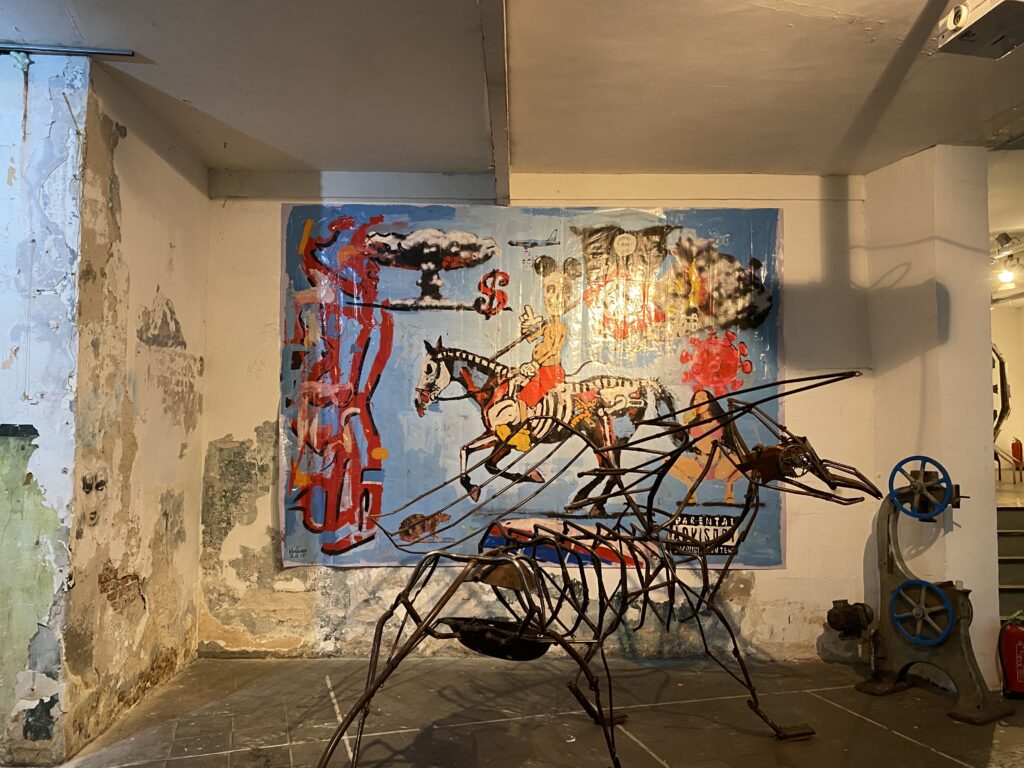
Paintings and a sculpture by Peter Klashorst. More about his shows and press coverage on the page Exhibitions & press.